無擷 · Exhibitions
At Taikang Art Museum: Blues on White
KeywordsArt exhibitions · Beijing · Video art
At Blues on White at Taikang Art Museum, an old Sony television in a passageway caught my attention.
On the screen, Kan Xuan was running through a subway passage, calling her own name—“Kan Xuan!”—and answering, “Ai!” Some people turned to look at her, but most kept walking.
As a Beijinger, I recognized the Line 2 transfer passage straight away. The raised anti-slip strips across the floor were especially familiar. They are the sort of detail I would rarely think to remember. Seeing them again on that old television felt unexpectedly close to home.
The television stood in the passage between the first and second floors. The person in the film was moving through a corridor, and so were the visitors watching her. I liked how the place I was walking through connected with the space on screen. The texture of the old television picture suited the footage from the 1990s, too.
There were several arrangements like this. Around Gao Wenqian’s Twenty-Four Hours were old televisions, a vase and a surface covered with fabric. Together with the images, they recalled the homes of the 1980s and 1990s. They brought back something of that period, including the place a television used to have in everyday life.
A large skeleton stretched overhead. At first I thought it looked like a dinosaur, and I was not even sure whether it was a work or part of the display. It crossed the gallery, becoming difficult to separate from the surrounding space as people walked beneath it. The placement of the works and the way visitors moved around them had clearly been considered.
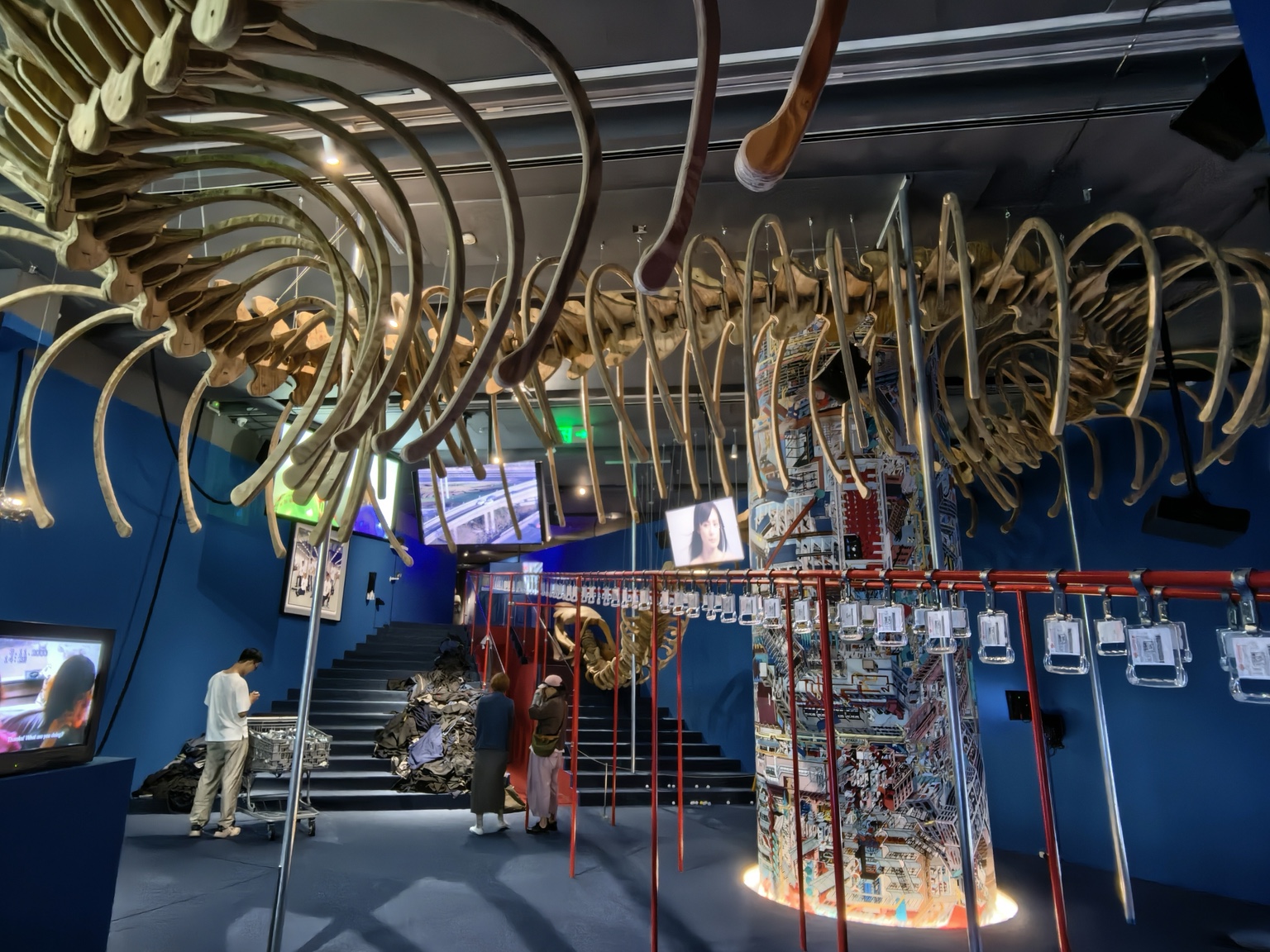
These arrangements made me want to keep looking. Even when I could not yet explain a work, there was already something to respond to and think about.
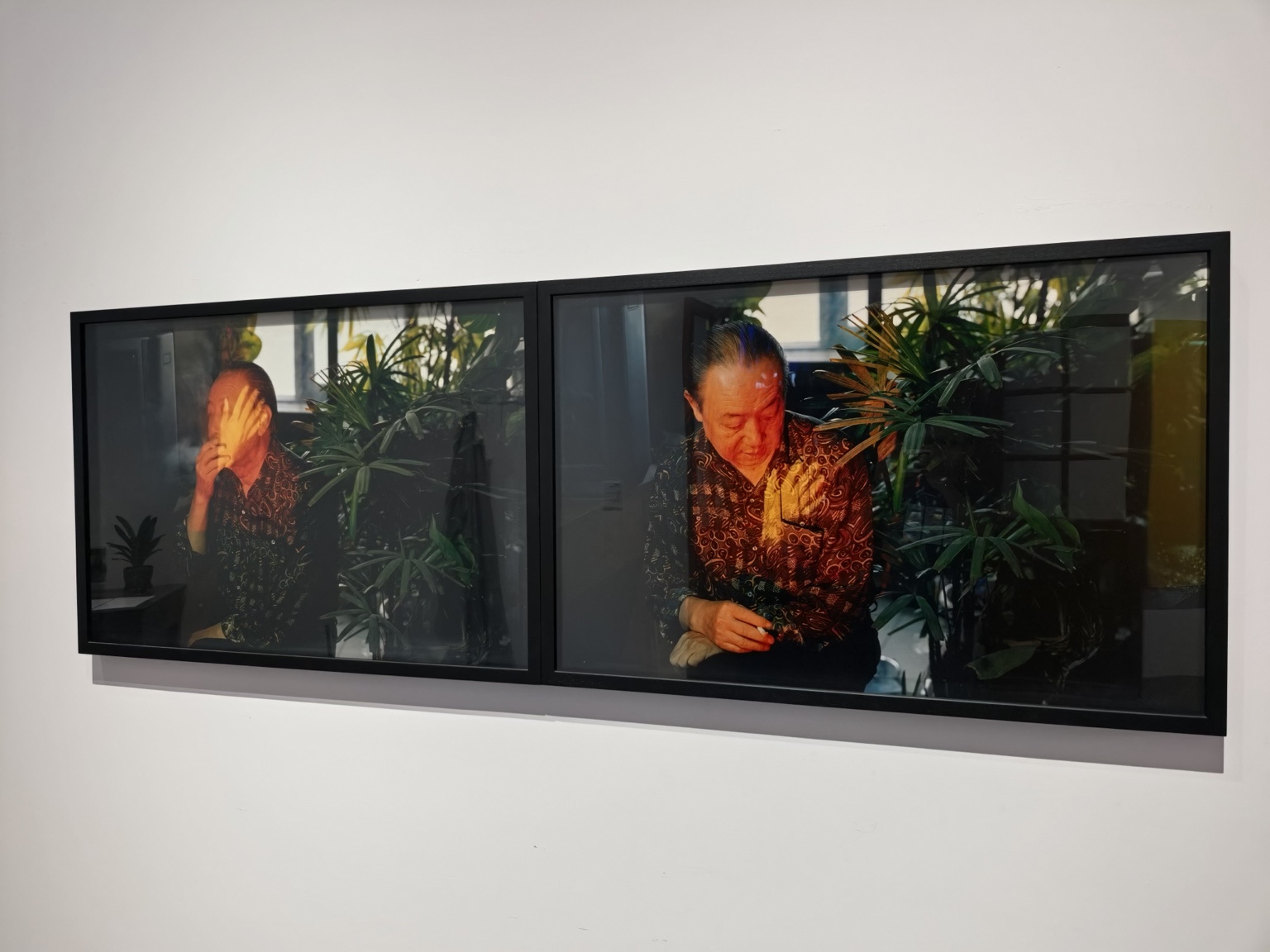
In Song Dong’s Touching My Father trilogy, I paid more attention to the father’s reactions. Song projected an image of his hand onto his father’s body, touching him in this way. His father seemed reserved at first; I read a little resistance in his manner. As the process continued, he gradually accepted this unusual form of closeness.
That change interested me. It is easy to notice how a son expresses affection, but how a father receives it is worth watching too. He has to get used to what his son is doing, and to being the person receiving that attention. There is very little movement in the images, yet the father goes through a gradual shift from reluctance to cooperation. Watching him, I felt that some of the awkwardness between family members could slowly ease through such an encounter.
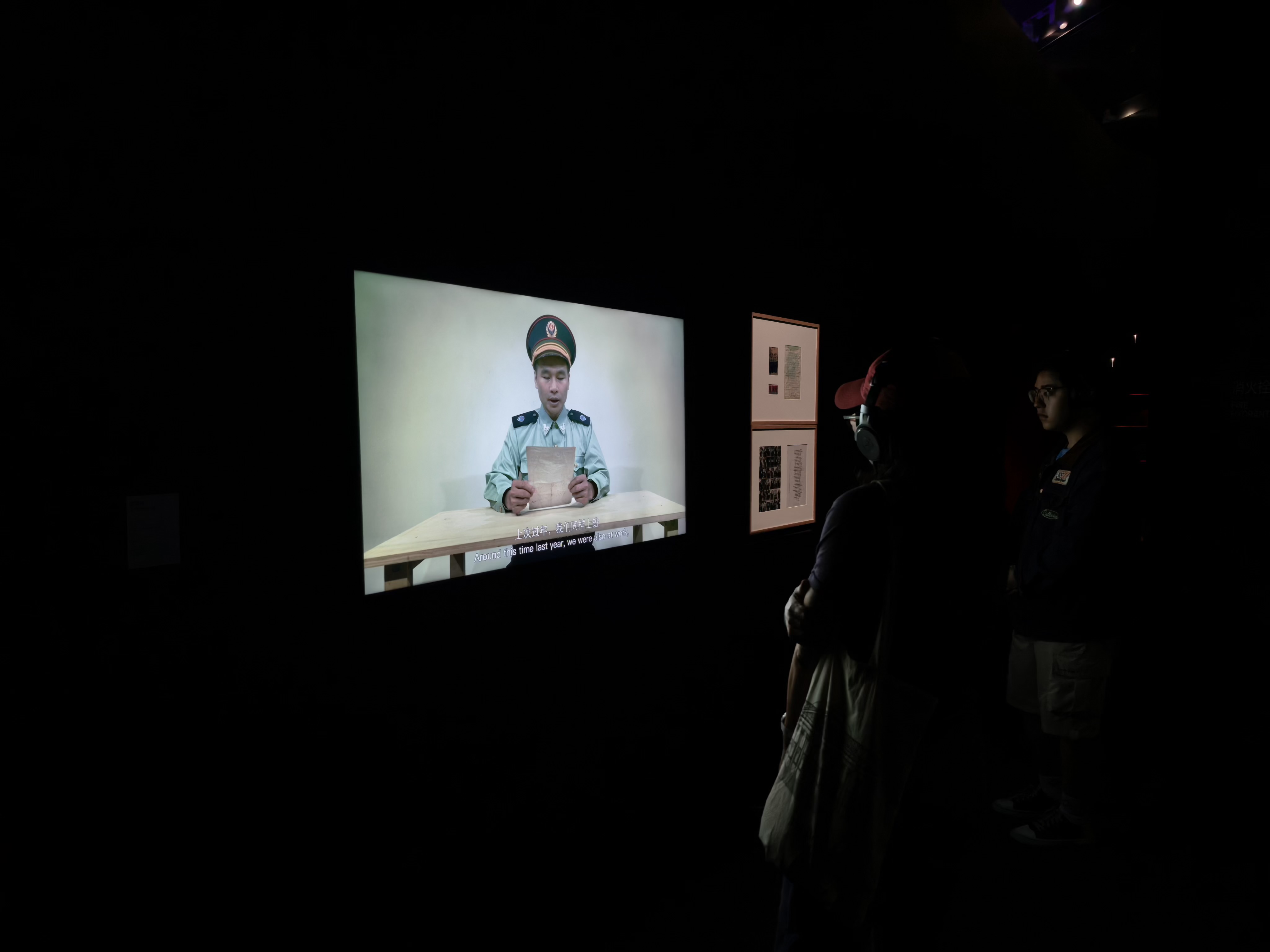
Li Binyuan’s The Last Letter also concerns his father, and its approach is particularly affecting. His father had worked away from home in Dongguan and learned Cantonese while looking for work. Years later, the artist returned to that city. He divided his father’s last letter home into thirty-six passages and asked thirty-six security guards to teach him how to read them in Cantonese. He then recited the complete letter himself.
What moved me was this process of learning, bit by bit. A son learns from strangers how to read the words his father left behind, while also approaching the circumstances in which his father had lived. The things written in the letter remain, as does the language his father learned. These are some of the places where the son can still look for a better understanding of him.
Another of Li’s works, Freedom Farming, is puzzling at first: a man repeatedly leaps and falls into muddy water, covering himself in mud as people watch. The action initially seemed clumsy and exhausting. Learning that the plot was farmland inherited from his father gave the images another dimension. His relationship with his father and his hometown came down to a particular piece of ground, which he returned to and encountered with his body.
These works all concern fathers, but they leave us with different processes to watch: accepting an approach, learning to read a letter again, returning to a piece of land. They give the emotions time to develop. Much of what they evoke emerges as we watch those actions unfold and repeat.
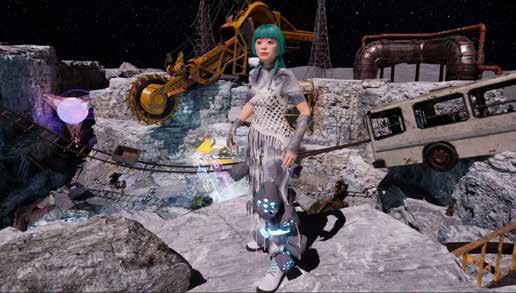
Zhao Meng’s Black Genie places family memories in a space built from three-dimensional animation and a computer game. Its hospital, child and birth scenes already suggest a kind of “cyber maternity ward.” The digital boy is connected to the artist’s second elder brother, who died at birth. His likeness is reconstructed from old photographs and given another form in a virtual environment.
In Tao Hui’s The Dusk of Teheran, a young Iranian woman in a wedding dress sits in the back of a car, talking to the driver about her life. She smokes and speaks openly about her frustrations in love. Her hair shows beneath her bridal veil. She differs from the image of Iranian women I usually have in mind, with a hint of unwillingness to meet traditional expectations.
Her words come from Anita Mui’s monologue at her farewell concert. Mui also wore a wedding dress in her final concert: one woman faces her fans on stage, while the other speaks from a car in Tehran. A wedding dress usually suggests the beginning of a new life. In these two settings, it accompanies a look back at a life already lived.
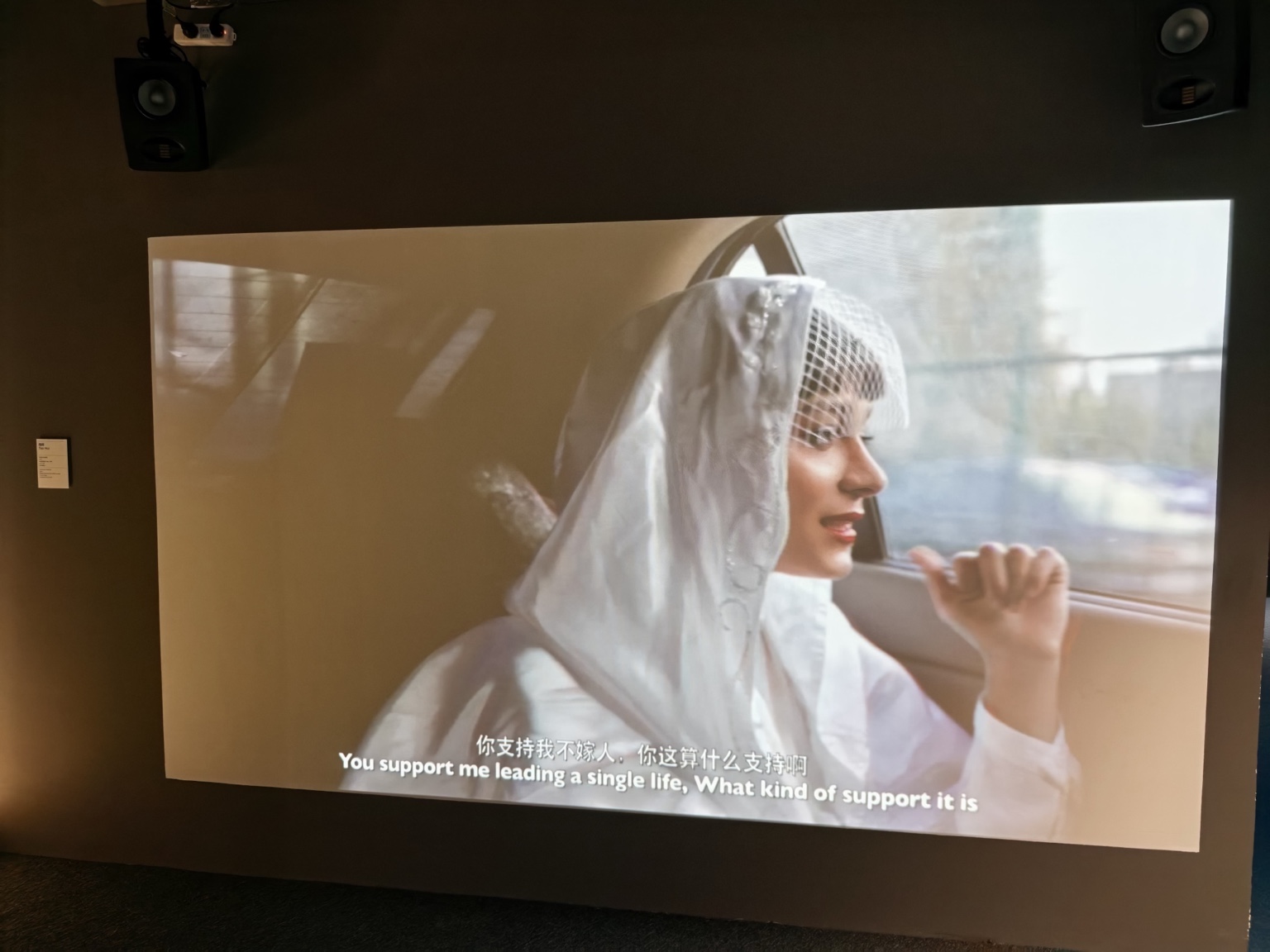
Remembering that Mui was then nearing the end of her life makes those words about love and waiting harder to pass over. Someone can go a long way in her career and still think about another life she never had. Achievement and unfulfilled wishes do not cancel each other out. Listening again to the woman in the car, I hear questions about how she hopes to spend her life, and how much distance remains between the life others imagine for her and the one she wants herself.
These works brought me back to Capital and The Wealth of Nations, displayed at the beginning of the exhibition. Those books seemed to promise a broad opening, while many of the works that followed settled on small things: a letter sent home by a father, someone calling her name in the subway, a woman talking about her life in a car.
There are larger circumstances behind these things. Why did the father leave home to work, and why did he need to learn another language? How does someone live in a city, and what ties remain to the place they came from? The personal feelings in this exhibition often arise within such concrete conditions.
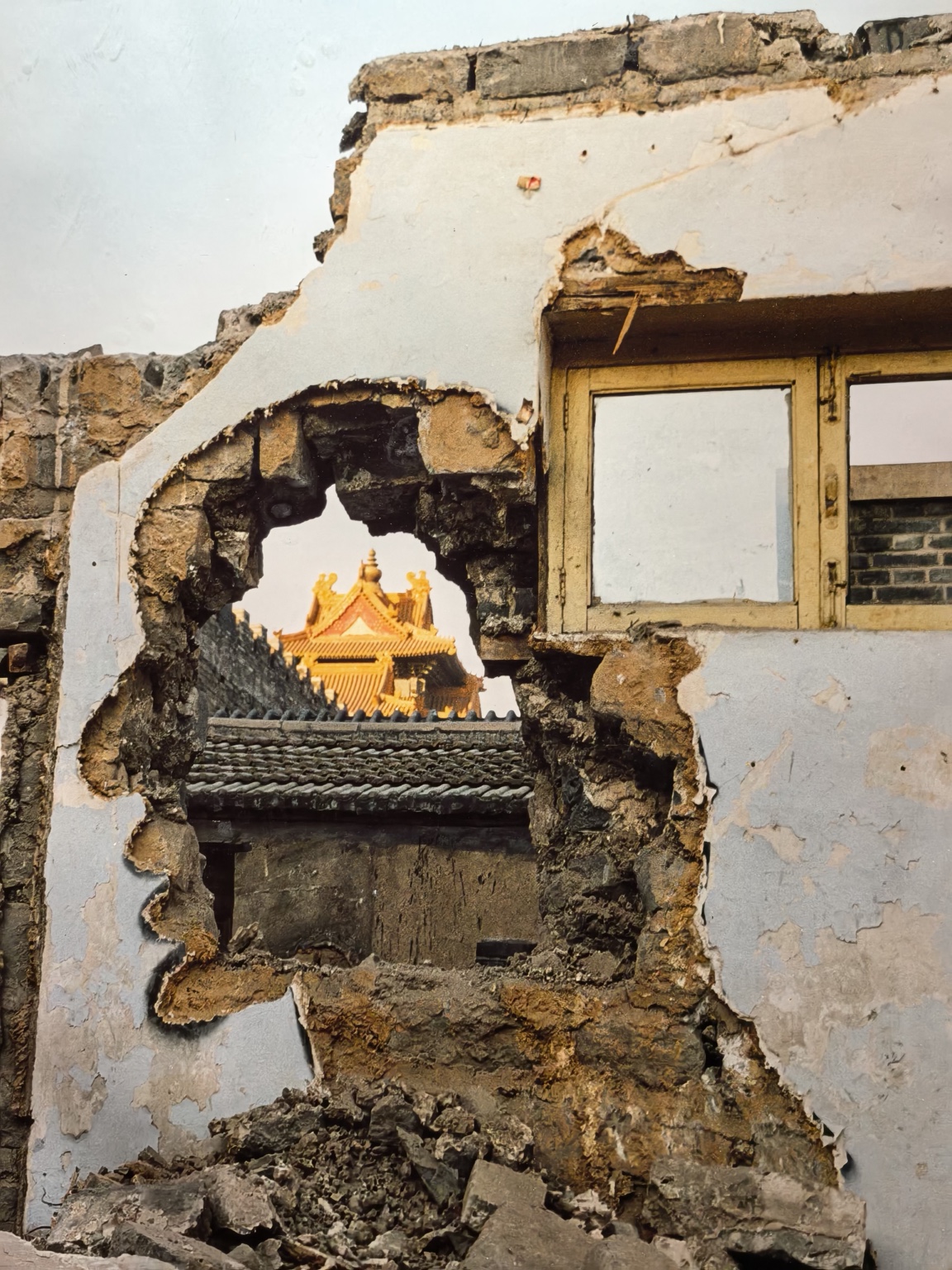
Zhang Dali’s Demolition: Forbidden City prompted similar questions. A broken wall stands in the foreground, with a preserved historic building in the distance. In the same city, some places continue to receive visitors while others, once lived in, change very quickly. Looking through the outline in the wall, I wondered what had been here, who had lived here, and where they had gone.
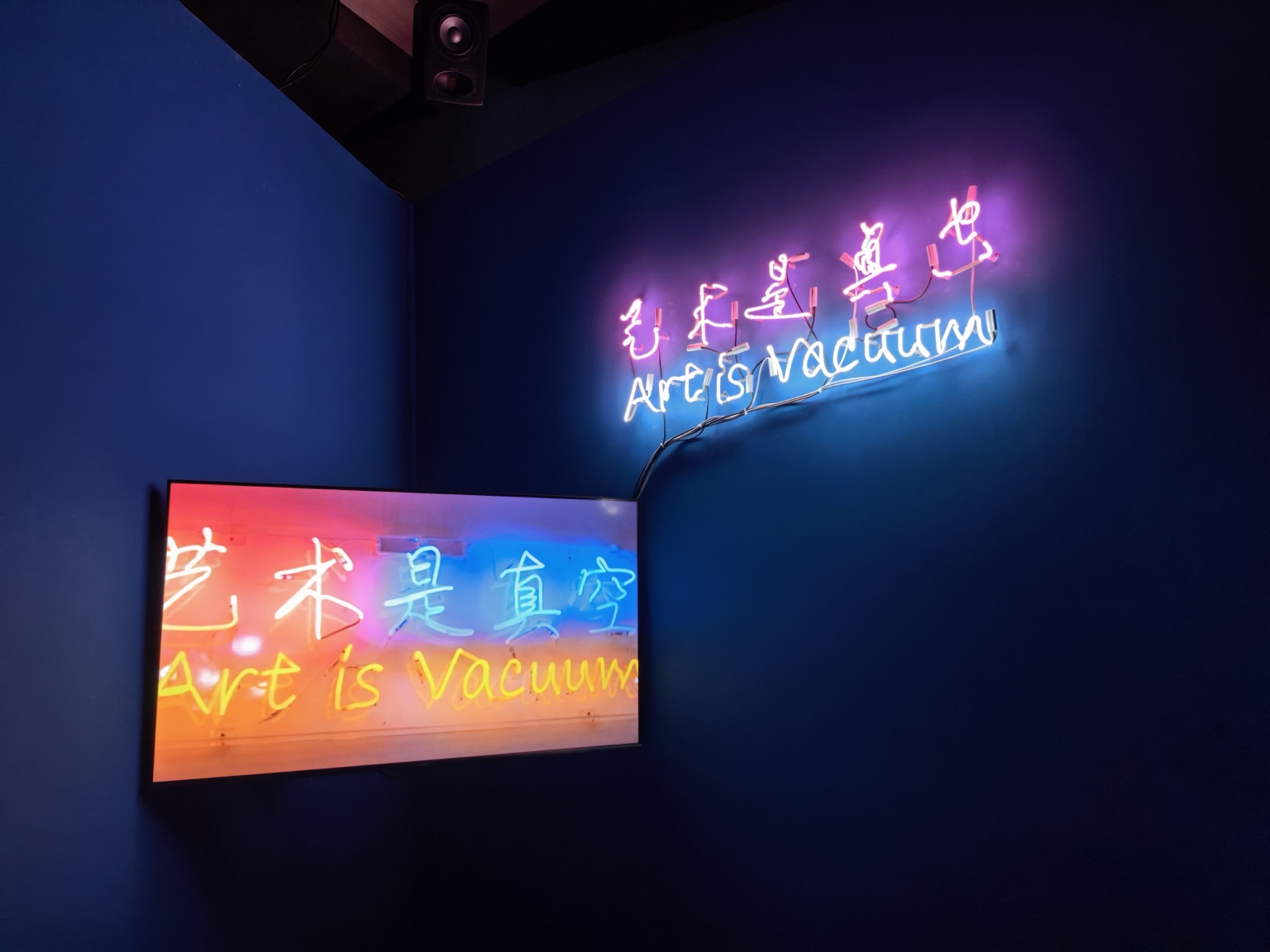
In a corner, Li Liao’s neon sign reads “Art is Vacuum.” Here I felt able to relax a little. At an exhibition, it is easy to assume that we ought to be serious and, ideally, understand every work. This sentence let me set that tension aside for a moment. The works about family, loss and life remained serious, and the people looking at them could still feel at ease. I liked that balance.
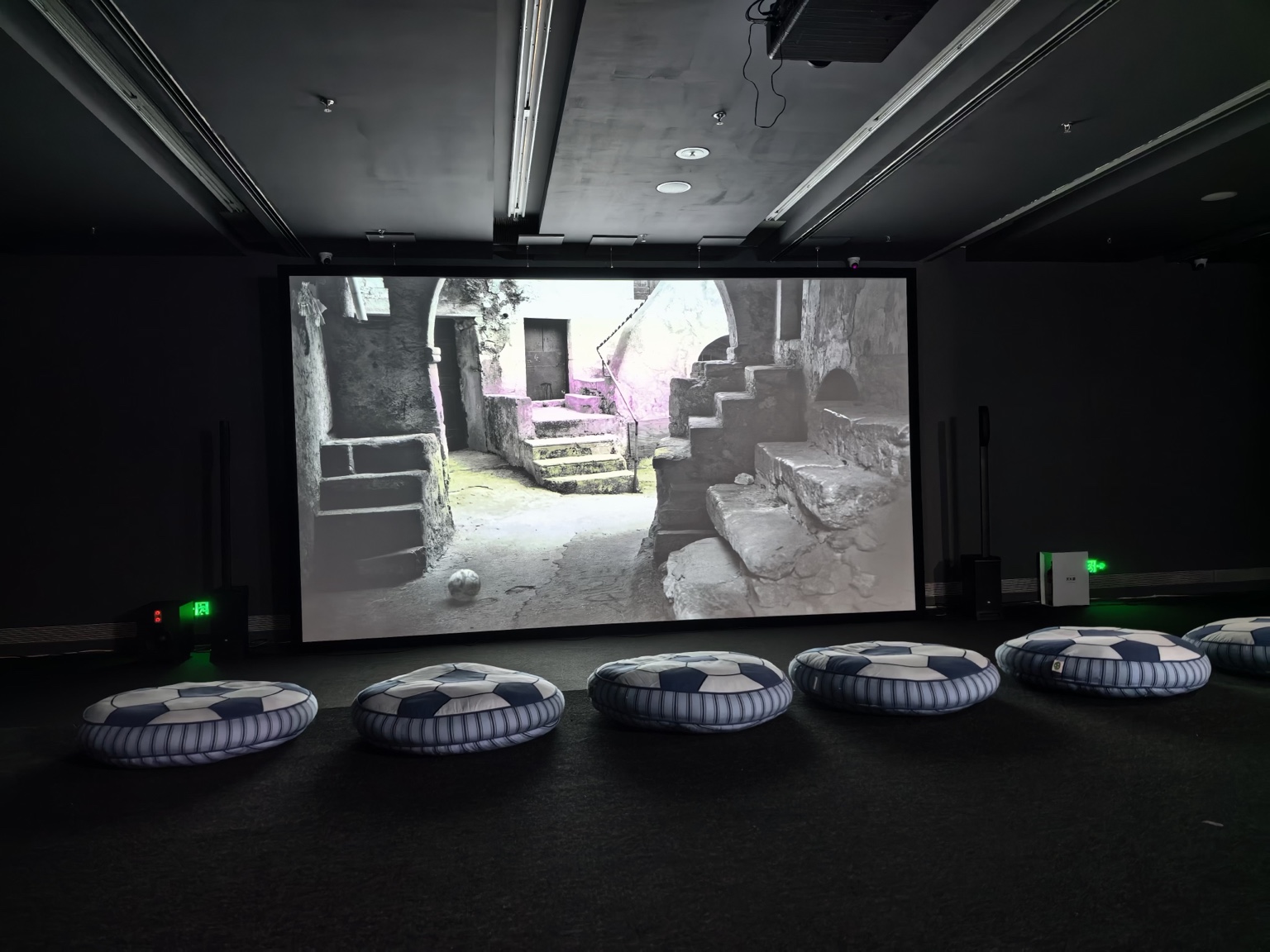
One of my favourite works was Abbas Kiarostami’s Take Me Home. In black and white, a football rolls down steps, passing through streets, arches and gaps between buildings. Its bounces and the sounds of its landings have a rhythm. A few movements looked so unusual that I even wondered whether the ball had been added in post-production.
At first I thought about time and gravity. Water flows downhill, and the ball keeps making its way down the steps. After a while, though, I mostly wanted to see where it would bounce next and which corner it would disappear around. The light and shade on the buildings, and the different heights of the steps, all became worth noticing because of the ball.
There were cushions patterned like footballs in the gallery. It was a thoughtful arrangement: a place to sit and spend time watching something simple. There is plenty to think about in the film, and simply following the ball is already a pleasure.
Near the end was Yan Bing’s Dividing Potatoes No. 3. The painting shows whole potatoes and irregular cut pieces. My first thought was how ordinary potatoes are, and how much they do to feed people. In a kitchen, they would probably go straight into a meal. In the painting, I began to notice the shape and cut surface of each piece.
I also thought about how a piece with an eye can be planted again. Dividing a potato can lead to more potatoes growing. That association brought the exhibition back to something very basic for me: people need to eat, things keep growing, and life goes on.
Later, learning that the curator, Xin Yunpeng, is himself an artist working mainly with installation and video gave me another way to understand the exhibition. He seems attentive to how a work will be encountered: where people pass, where a screen sits, when they can sit down, and how the surrounding space enters into what they see.
Kan Xuan’s video in a passage, the cushions in front of the football, the skeleton crossing overhead—these are all concrete decisions. The movement, sound and space in the works extend into the visitor’s surroundings. They give the exhibition different rhythms: some places invite us to keep moving, others to stay for a long time. I think this has something to do with Xin’s own experience of video and installation. He attends to the content of a work and to what it feels like to stand in front of it.
This is part of why I liked the exhibition as a whole. It contains many difficult things, yet leaves room for ease and curiosity. Serious expression does not require visitors to stay tense or arrive immediately at an interpretation. When I described it as having a strong sense of art without feeling oppressive, this was roughly what I meant. I left with some works still unresolved, but with a clear memory of wanting to spend more time there.
References
- Taikang Art Museum: Blues on White exhibition introduction
- China Newsweek: Exhibition and selected works
- Song Dong on Touching My Father, in the OutLook exhibition materials
- KADIST: Li Binyuan, The Last Letter
- M+: Background to Li Binyuan’s Freedom Farming
- FIRST Fantastic Film Festival 2025 catalogue, pp. 264–265 (Black Genie image source)
- M+: She Plays—The Dusk of Teheran
- Esther Schipper: Tao Hui’s The Dusk of Teheran and Anita Mui’s bridal dress
- M+: Reimagining the Street—Kan Xuan
- Pera Museum: Take Me Home
Cite this article
無擷. (2026). At Taikang Art Museum: Blues on White (Version 0.1). 無擷.
Permanent link:https://wuxie.ink/en/notes/taikang-blues-on-white/