無擷 · Note
Macau's Character
KeywordsMacau · Urban culture · Travel
When I first arrived in Zhuhai, I felt a strong sense of unfamiliarity. Why did the city seem to be still in the 1990s? My immediate thought was that it seemed to have missed the round of modernization I was used to seeing elsewhere. Parts of Macau gave me a similar feeling. That impression faded as I explored more, but I still wanted to understand where it had come from.
Macau’s landmarks are unmistakable: the Ruins of St. Paul’s, Portuguese architecture, the casinos. Yet I found it harder to say what sort of character the city had as a whole. Its many distinctive features did not add up to an equally clear overall impression.
At the Macau Museum, there was plenty to take in at every stage: fishing villages and maritime life, port trade, the arrival of the Portuguese, Catholicism, and exchanges between China and the West. Putting that history alongside today’s gambling and tourism, I kept feeling that a chapter was missing. Had Macau gone through anything like Hong Kong’s transformation, bringing these different origins together into a recognizable modern urban culture?
Hong Kong has a very strong sense of itself as a city.
Migration in the twentieth century brought workers, capital, and different experiences of life to Hong Kong. Chinese society, British colonial institutions, international trade, and the later growth of manufacturing, finance, and commerce gradually produced a new kind of urban life. From the 1970s through the 1990s, films, television dramas, Cantopop, advertising, and fashion kept portraying that life and carrying it elsewhere.
Those cultural products mattered. Many people knew the Hong Kong of its films before they had ever visited. They recognized the way people spoke and copied its clothes, spending habits, and ways of living. Hong Kong could turn its city life into something people elsewhere wanted to take part in.
By then, “Chinese culture plus British culture” could no longer explain what felt distinctly Hong Kong. Something new had grown out of the combination, with considerable force of its own.
Macau did not go through the same process on a comparable scale. It has a long history of international connections and a highly developed tourism industry, but its film, television, and music industries have not reached Hong Kong’s scale or influence. To an outsider, Macau’s landmarks and tourist image are clear enough. Its cultural expression as a modern city is less pronounced. That is mainly what I mean when I say I found its character harder to make out.
More than four centuries of Portuguese presence left many influences in Macau. At the same time, the Chinese community’s ties to Lingnan and the Pearl River estuary never broke. Language, beliefs, business relationships, and neighborhood life retained considerable continuity. The religious, educational, and public institutions introduced by the Portuguese existed alongside them for a long time.
The Na Tcha Temple still stands just behind and to one side of St. Paul’s. The closeness of a ruined church and a temple devoted to a folk deity makes that relationship fairly easy to see. On the façade of St. Paul’s itself, Chinese characters appear beside religious images. Several traditions sit together, and their origins remain recognizable.
I had also heard that some of the chrysanthemum carvings on the façade had a Japanese connection, though I could not pick them out when I was there.
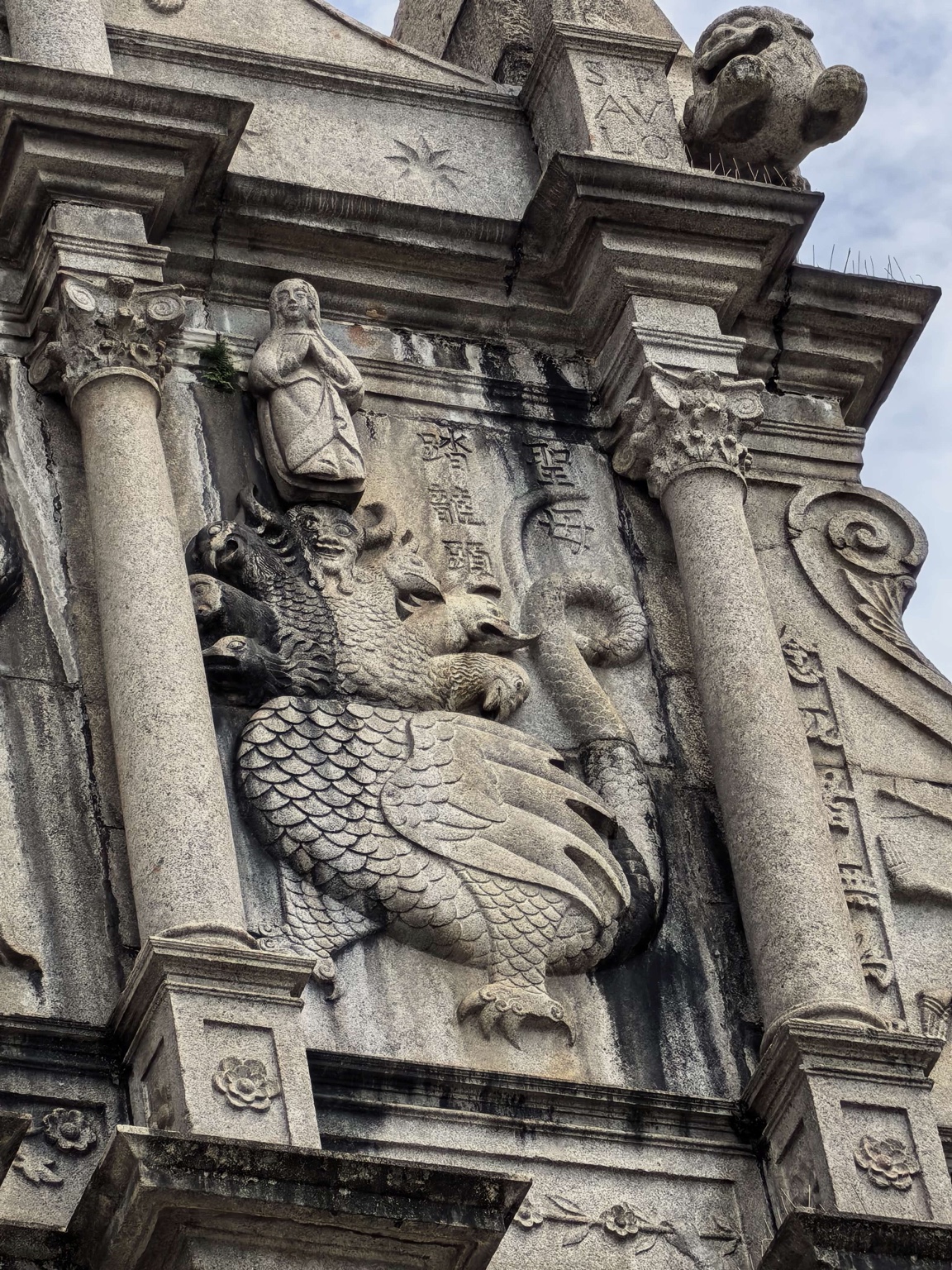
It is fair to describe Macau as a meeting of Chinese and Western cultures. What I felt, though, was that many things had been here for a very long time. Some had mixed together; others still looked distinctly like themselves.
Macanese culture developed its own language, food, and traditions of everyday life. Much of daily life in Macau also remained close to that of the surrounding Chinese communities. Even the beef offal, pork chop buns, and Portuguese egg tarts I tried on this trip left me with an overall feeling of familiarity with the Pearl River Delta. I could sense outside influences without feeling very far from that wider way of life.
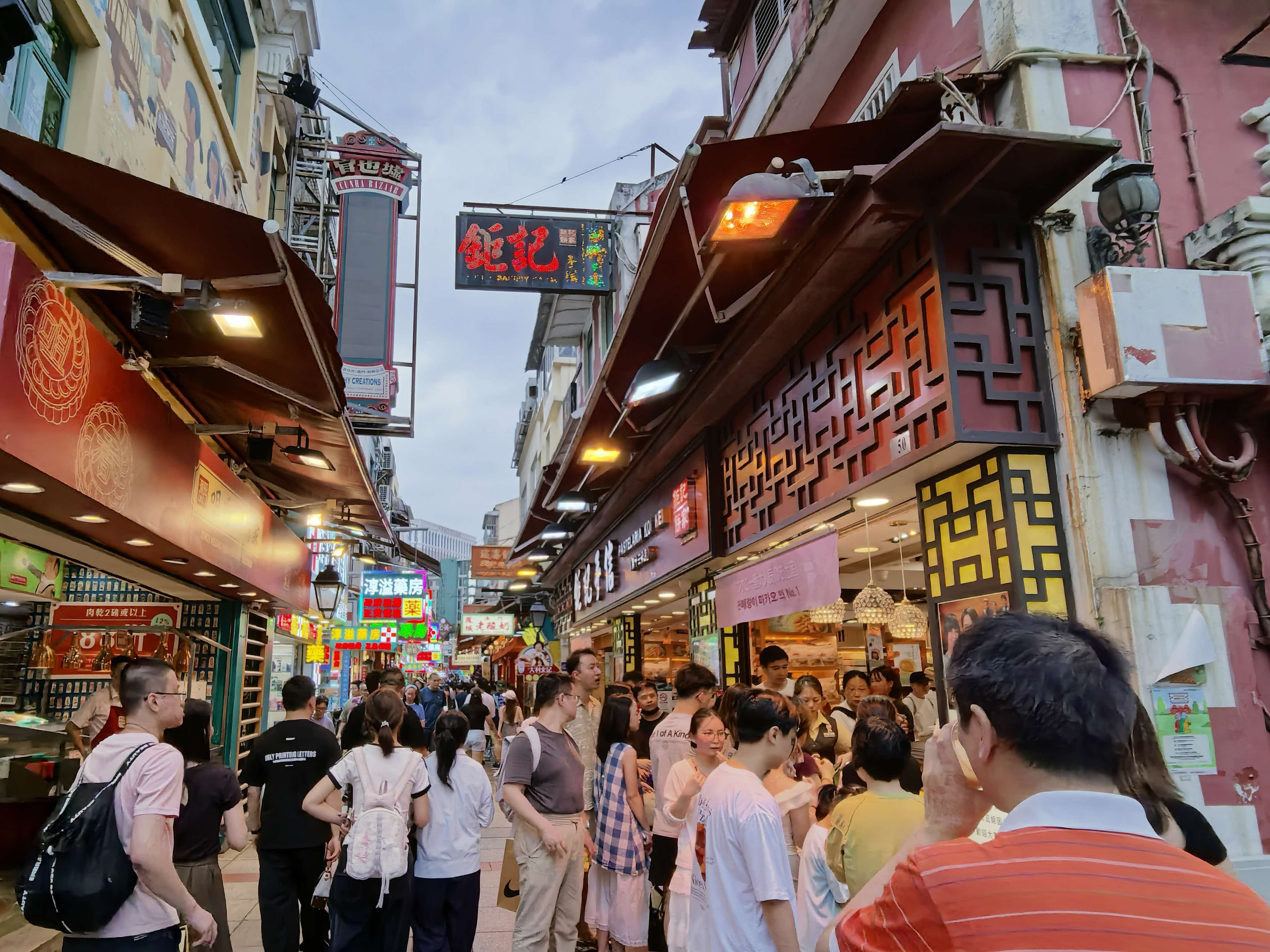
Perhaps this is part of the difference between Hong Kong and Macau. Through its twentieth-century changes, Hong Kong brought elements from different origins into a powerful modern culture. In Macau, the historical layers remain easier to distinguish: Lingnan Chinese society, Portuguese and Catholic traditions, connections formed through maritime trade, and later gambling and international tourism. New things kept arriving without entirely covering what was already there.
But using twentieth-century Hong Kong as the constant reference makes some of Macau’s important experiences easy to overlook.
If we went back to the sixteenth and seventeenth centuries, Macau’s place in the world might look quite different. It was already involved in important maritime trade, missionary work, and the exchange of knowledge. St. Paul’s College provided language instruction and other training for missionaries preparing to travel to mainland China and Japan. Macau looks small today, but it connected more places then than I had imagined.
Near St. Paul’s, I saw a religious painting showing many people on crosses. In a discussion with AI, we connected it with the story of the Twenty-Six Martyrs of Nagasaki in 1597. I was curious: why was this episode of Japanese history being shown in Macau?
Macau had deep connections with the spread of Catholicism in Japan. Missionaries traveled from here to Japan; after Christianity was prohibited there in the seventeenth century, missionaries and Japanese Christians also came to Macau for refuge. Some of them made religious paintings. Macau’s churches were involved in this history over a long period, which helps explain why works commemorating Japanese martyrs would be found here.
The title and history of the particular painting I saw still need checking. But the discussion made me realize that Macau’s history cannot be understood only through China and Portugal. Japan was part of it, as were other parts of Asia. People, goods, religion, and knowledge traveled along these connections, and Macau was once an important stop.
These experiences are harder to encounter in the same way as Hong Kong’s later influence through films and music. A film can be watched again and again, and a song can be sung for years. To understand the importance of old trading relationships and missionary networks, you need to connect the people and places involved. With that background, some of the museum’s seemingly scattered exhibits become easier to understand.
I find Macau’s long position between several worlds worth thinking about further, beyond the familiar description of Chinese and Western cultures meeting.
It kept close ties with the surrounding Chinese communities while continuing to encounter places much farther away. Different connections left different influences, and they did not all become the same thing. The city’s character may have a lot to do with this long coexistence.
Before coming to Macau, I had expected a gambling city along the lines of Las Vegas. The Parisian, the Venetian, and the Londoner fitted that picture quite well. These integrated resorts drew directly on the Las Vegas model, bringing accommodation, shopping, gambling, and entertainment together, then using the names and scenery of European cities to give each resort its theme.
This part of Macau is certainly very modern. But the image of modernity it presents draws heavily on other cities and the international resort industry. Hong Kong once turned its own urban life into cultural products and sent them outward. These Macau hotels bring images of other places in, attracting people to spend money and take holidays here. Both approaches can have a considerable economic impact, but the urban cultures they produce may differ.
Looking back at my first impression of a place still in the 1990s, I do not think it entirely contradicts the highly modern Macau I saw later. Some parts have changed very quickly; others have continued for a long time. New industries and spaces have developed while older social and cultural patterns remain. The whole city has not become one kind of place.
My interest in Macau gradually settled on how these different parts live alongside one another. It did not give me Hong Kong’s strong, unified sense of a modern city. But looking a little further back, I could see that it had long been connected with many other places.
Some of those connections remain; others have left their traces. Following them may be how I slowly come to understand Macau’s character.
Sources
- Hong Kong Heritage Museum: Hong Kong Pop 60+
- Cultural Affairs Bureau: Na Tcha Temple
- Cultural Affairs Bureau: The Ruins of St. Paul's
- Macao Government Tourism Office: Peony and chrysanthemum motifs at St. Paul's
- Macao Cultural Heritage: St. Paul's College
- Revista de Cultura: The Japanese in Macau
- Sands Retail: The integrated resort model
Cite this article
無擷. (2026). Macau's Character (Version 0.2). 無擷.
Permanent link:https://wuxie.ink/en/notes/macaus-character/